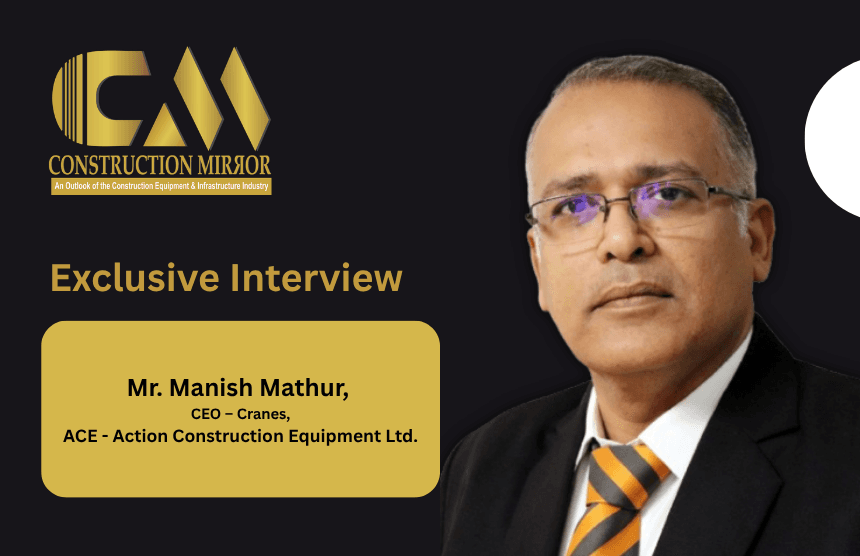
ACE’s approach to next-generation crane design is centred on Multifunction capability, safety, precision, and operator-centric engineering. Platforms such as the NX series reflect a shift toward structurally optimised designs, including single-chassis architecture for greater stability and balanced load distribution. The next decade will be defined by three converging forces, namely, digitisation, sustainability, and application specificity. Cranes will evolve into intelligent, connected systems with advanced automation, predictive analytics, and enhanced safety architectures.
Q. India’s construction and infrastructure ecosystem is entering a new phase characterised by large-scale transport corridors, urban verticalisation, renewable energy installations, and industrial expansion. In this context, how do you see the role of cranes evolving in enabling these complex infrastructure projects, and what broader shifts are shaping the crane industry today?
India’s infrastructure push is fundamentally reshaping crane utilisation, from conventional lifting machines to precision-driven, mission-critical assets. With projects ranging from metros to high-rise buildings, renewable energy initiatives to logistics corridors, cranes are called upon to provide increased stability, load management, and flexibility in tight working conditions. At ACE, we are witnessing an increasing trend towards smart and application-engineered equipment with built-in safety features, telemetry, and automation. The emphasis is no longer on maximum lifting capacity but on overall equipment performance and total cost of ownership. Increasing localisation, digitalisation, and safety are changing the course of the crane industry.
Q. ACE has long been recognised as a dominant force in the pick-and-carry crane segment, a category that has become almost synonymous with India’s construction landscape. From your perspective, what factors have enabled this equipment category to remain so relevant across diverse construction environments?
Pick-and-carry cranes continue to play a central role in India’s construction ecosystem, largely due to their versatility, mobility and cost efficiency. Unlike conventional cranes that depend on outriggers and well-prepared surfaces, these machines are designed to move seamlessly with load—even across congested, uneven or space-constrained sites. This inherent flexibility allows them to handle both lifting and transportation tasks without the need for additional equipment, making them especially valuable in infrastructure-limited environments. As a result, they are widely used across roads, precast applications, and industrial maintenance and urban projects. At ACE, our leadership in this category has been built on continuously refining the pick-and-carry format for Indian conditions—enhancing stability, manoeuvrability and overall cost efficiency. Our focus has been on improving safety, operator comfort and lifecycle value, while ensuring the machines remain easy to maintain and economically viable. This combination of adaptability, reliability and strong resale value continues to keep the category highly relevant, even as construction requirements become more complex.
Q. The development of advanced platforms such as the NX series cranes reflects ACE’s emphasis on engineering innovation and productivity-driven equipment. Could you elaborate on how the company is reimagining crane design to meet modern expectations around safety, efficiency, and operational flexibility?
ACE’s approach to next-generation crane design is centred on Multifunction capability, safety, precision and operator-centric engineering. Platforms such as the NX series reflect a shift toward structurally optimised designs, including single-chassis architecture for greater stability and balanced load distribution. In fact, our upgraded line-up is engineered to meet rising demands for efficiency, precision and operator comfort. We are integrating advanced safety systems, better ergonomics, intuitive controls, and low creep-speed capabilities to improve operational accuracy in complex environments. Additionally, innovations such as clutchless transmission and AI-assisted systems reduce operator fatigue and error. The emphasis is on delivering machines that combine high productivity with superior ergonomics, reduced downtime and enhanced lifecycle efficiency.
Our new range of products reiterates our strong commitment to ‘Made-in-India’ innovation, with most of the systems, components, and design innovations being homegrown. We continue to break new ground in indigenous manufacturing, with our design philosophy aligning with the vision of the Government of India for a self-reliant India, with global production scale.
Q. Beyond pick-and-carry cranes, ACE has steadily expanded its portfolio across tower cranes, crawler cranes, and truck-mounted cranes. How is the company positioning its product portfolio to address the increasingly diverse lifting requirements emerging across infrastructure, industrial, and energy projects?
As project requirements diversify, ACE has strategically ventured beyond pick-and-carry cranes into tower cranes, crawler cranes, truck-mounted platforms and telehandlers. This has helped us to serve a broad range of needs, from urban construction to heavy industry. Our portfolio is increasingly modular, technology-enabled and application-specific, allowing customers to select solutions aligned with project scale and complexity. By combining indigenous engineering with global
standards, ACE ensures performance reliability, cost efficiency and adaptability across sectors, positioning itself as a comprehensive solutions provider in material handling and lifting equipment.
Q. Construction equipment is gradually becoming more connected and data-driven, with telematics, predictive maintenance, and fleet monitoring systems gaining importance. How is ACE integrating digital technologies into its crane platforms to improve performance and lifecycle efficiency?
ACE has embedded digital intelligence as a core design principle, not an add-on. Our equipment is now equipped with real-time telematics and IoT-enabled monitoring that provides continuous visibility into machine health, utilisation, and operator behaviour. Predictive maintenance systems analyse component-level data to pre-empt failures, reducing unplanned downtime. Remote diagnostics enable service teams to identify faults without on-site visits, accelerating response times significantly. The F250 Ultra’s SCOS, ALSS, and RAS safety systems, both configurable via the ACE Live mobile app, represent an AI-assisted crane operation in practice. At EXCON held last year, we unveiled AI-assisted pick-and-carry cranes and intelligent tower cranes, signalling the company’s full transition toward connected, data-driven lifting solutions.
Q. As environmental considerations gain importance across the construction sector, equipment manufacturers are increasingly exploring cleaner technologies and energy-efficient systems. How is ACE preparing its crane portfolio to align with evolving sustainability expectations?
Sustainability is a key pillar of ACE’s product development strategy. We are focusing on fuel-efficient systems, optimised hydraulics and design improvements that reduce material usage and lifecycle waste. Our portfolio includes electric equipment, energy-efficient platforms and machines compliant with evolving emission norms. Advanced engineering and electronic optimisation are enabling measurable fuel savings while maintaining performance. Additionally, zero-emission electric platforms and low-noise solutions are being introduced for urban applications. The goal is to deliver equipment that balances
productivity with environmental responsibility, supporting greener infrastructure development.
Q. What technological, operational, or market shifts do you believe will define the next decade of the crane industry in India, and how does ACE envision its role in shaping that future?
The next decade will be defined by three converging forces, namely, digitisation, sustainability, and application specificity. Cranes will evolve into intelligent, connected systems with advanced automation, predictive analytics and enhanced safety architectures. Demand will grow for versatile, mid-range and application-specific equipment driven by broader contractor participation. At the same time, stricter emission norms and global competitiveness will accelerate innovation in cleaner technologies and indigenous manufacturing. Given our track record last year, we are well-positioned to lead this transition by
investing in R&D, expanding digital capabilities and diversifying our product portfolio. This places us at the forefront of a more future-ready and resilient construction equipment ecosystem in India.