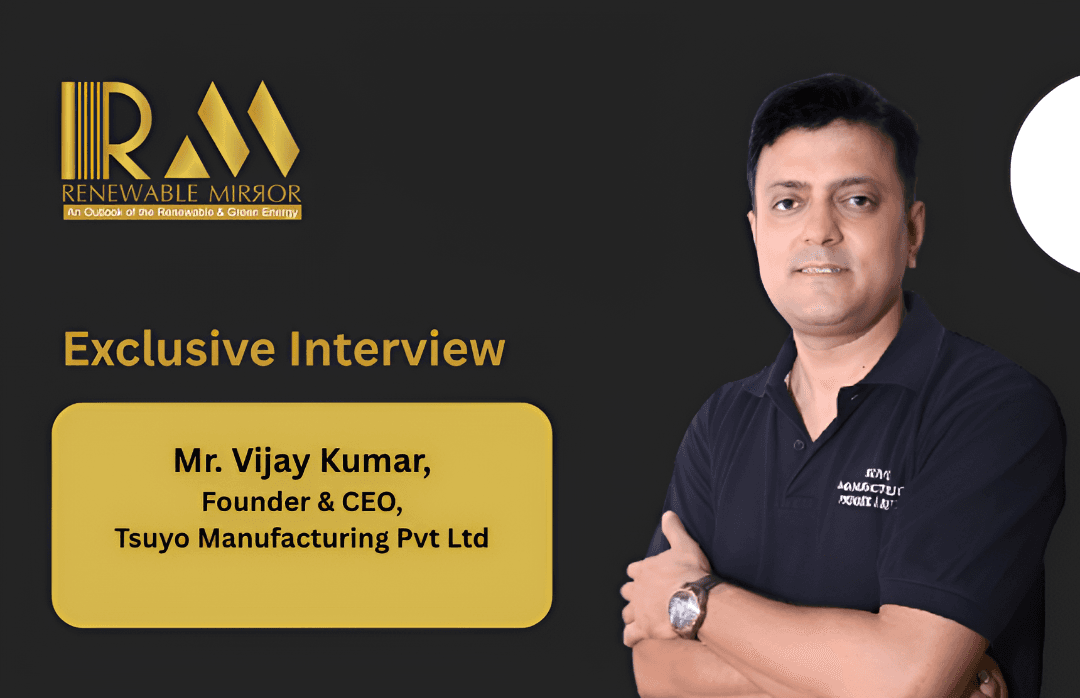
1. Tsuyo was founded in 2020 with a vision to reshape the EV industry through advanced powertrain solutions. What inspired the company’s founding vision, and how has the journey evolved since then?
Ans) With over a decade of experience in the automotive industry, we have a clear vision: the manufacturing of vehicles is well-supported by a long-standing legacy of component fabrication and assembly. However, critical components such as the powertrain and power source require a transformative and innovative approach to define e-Mobility. In terms of power sources, battery production is heavily reliant on imported cells, as cell manufacturing in India is virtually non-existent. This dependency extends to countries like China, Japan, and Korea.
Regarding the powertrain, the motor and drive systems present new challenges that demand a comprehensive re-evaluation. These systems are considered key technologies within electric vehicles (EVs), crucial for delivering optimal performance and user experience. As electric motor technologies evolve, the technological advancement of EVs becomes a sustainable area where continuous innovation and engineering efforts can position any entity ahead of its competitors, provided there is a focus on consistent research and development.
With a background in engineering, particularly in metals and materials, and extensive exposure to the automotive industry, specializing in research and new product development, focusing on the powertrain sector in EVs was a natural choice. Additionally, with the rising demand and adoption of EVs, many core technologies—such as motors, controllers, and drivetrains—remain largely imported.
For India’s EV ecosystem to achieve sustainable and scalable growth, it is essential to develop these technologies domestically. Given the unique geographical conditions, driving behaviors, and duty cycles in India, there is an urgent need to create solutions tailored specifically for Indian OEMs. These solutions must address specific vehicle requirements and conditions, which cannot be sustainably achieved through the use of standard SKUs imported or offered by foreign companies, as these are developed with other countries’ conditions in mind. This realization led to the establishment of Tsuyo. Our objective is to deliver reliable, high-performance powertrain solutions that are both designed and manufactured in India, thereby supporting OEMs in their transition to electric mobility.
2. Your company designs and manufactures a wide range of EV components including electric motors, drives, converters, gearboxes, axles, and e-axle systems. How do you ensure performance, efficiency, and reliability across such a diverse product portfolio?
Ans) At Tsuyo, we adopt a holistic approach to EV engineering, focusing on the integration of components into a cohesive powertrain system. Our engineering teams design motors, controllers, gearboxes, and axles in a unified manner to optimize performance, efficiency, and durability across the entire drivetrain. We leverage various motor technologies tailored to specific applications, enabling us to provide customized solutions that meet diverse vehicle requirements.
In our commitment to manufacturing excellence and precision quality, we collaborate with partner companies and utilize job-work arrangements for certain hardware components. This strategy allows us to maximize the efficiency of our in-house manufacturing capabilities without compromising on quality. We are also expanding our manufacturing capacity with the development of a new 20-acre facility dedicated to manufacturing, testing, and validation, enhancing our ability to deliver integrated solutions.
Testing and validation are critical components of our process. Our systems undergo rigorous testing in both controlled environments and real-world conditions to ensure reliability. By combining robust engineering with comprehensive testing, we deliver solutions that meet the stringent demands of EV manufacturers.
3. Tsuyo’s electric motors cover a wide power range. How important is scalable motor technology in supporting different EV segments in India?
Ans) Scalability is crucial in a market as diverse as India, where the mobility landscape encompasses a wide range of electric vehicles, from small two-wheelers to commercial vehicles and industrial equipment, each with distinct performance requirements. By developing scalable motor platforms, we can support multiple vehicle categories with solutions adaptable to varying power and torque needs. This flexibility enables OEMs to produce a diverse array of electric vehicles while ensuring efficiency and reliability. Scalable powertrain technology is instrumental in facilitating electrification across a broader spectrum of mobility and industrial applications.
4. Your solutions cater to both on-road and off-road applications. How do you approach engineering solutions for such diverse use cases?
Ans) When designing powertrain systems, our starting point is always a rigorous analysis of the real‑world application profile and the duty cycle specific to the geography and operating environment. Vehicles across segments—from light urban mobility to heavy off‑highway machinery—exhibit vastly different load spectra, transient behaviors, and thermal constraints.
On‑road3W/4W vehicles:
These typically require compliance with IEC S9 duty cycles, characterized by highly dynamic load variations, frequent acceleration/deceleration, and regenerative braking events. The engineering focus here is on:
- High efficiency motors with optimized electromagnetic design (slot/pole combinations, winding topologies).
- Compact packaging to minimize weight and maximize volumetric power density.
- Advanced cooling strategies such as liquid jacket cooling or integrated heat pipes to manage transient thermal spikes.
- Inverter design with wide‑bandgap semiconductors (SiC/GaN) for fast switching and reduced losses.
Tractors and construction machinery:
These operate under constant torque and constant power duty cycles, often at low speeds but with sustained heavy loads. The engineering priorities shift toward:
- High‑torque motors with reinforced rotor structures and higher thermal mass.
- Continuous operation efficiency in the constant torque region, ensuring minimal copper and iron losses.
- Robust drivetrains with gear reduction stages optimized for mechanical shock loads.
- Enhanced cooling systems (forced liquid cooling, oil‑spray cooling) to sustain long‑duration operation under high ambient temperatures.
Engineering Approach
Our methodology is application‑driven customization, where each subsystem is tailored to the performance envelope of the target vehicle:
- Motor Design: Selection of topology (PMSM, SRM, induction) based on torque ripple tolerance, efficiency targets, and cost constraints.
- Cooling Systems: From passive finned housings for light EVs to closed‑loop liquid cooling with integrated chillers for heavy machinery.
- Drivetrain Components: Gear ratios, bearing selection, and lubrication systems are optimized for load cycles and terrain conditions.
- Power Electronics: Inverter and DC/DC converter architectures are tuned for switching frequency, EMI compliance, and thermal robustness.
Environmental Robustness
Given the diversity of operating environments—high ambient temperatures, dusty terrains, water ingress, and mechanical vibrations—our systems are engineered with:
- IP67/IP69K protection levels for enclosures.
- Redundant thermal management sensors for predictive derating.
- FEA for structural integrity under shock loads.
- Advanced control algorithms (field‑oriented control, torque vectoring) to ensure stable performance across variable conditions.
This technical framing highlights not just the application differences but also the specific engineering levers—motor topology, cooling architecture, drivetrain robustness, and electronics design—that are tuned to deliver optimal performance across diverse duty cycles.
5. Innovation and R&D appear to be central to Tsuyo’s strategy. How is your R&D team driving technological advancements?
Ans) Innovation and R&D are central to everything we do at Tsuyo. Our engineering teams are constantly working on improving motor efficiency, controller technologies, and overall powertrain performance.
We focus on developing advanced motor architectures, improving thermal management, and enhancing energy efficiency. Another area we are exploring is reducing dependence on rare-earth materials through alternative motor technologies.
At the same time, we are integrating smarter monitoring capabilities into our systems so that vehicle operators can track performance and detect issues early. These efforts help us deliver solutions that are not only efficient but also reliable and future-ready.
6. Tsuyo collaborates with technology partners and academic institutions. How do these partnerships support innovation?
Ans) Collaboration plays an important role in innovation, especially in a rapidly evolving industry like electric mobility.
At Tsuyo, we work with technology partners and academic institutions to access specialized expertise and research capabilities. These partnerships help us explore new motor technologies, power electronics solutions, and advanced materials.
They also allow us to accelerate product development by combining academic research with practical industry experience. This collaborative approach helps us bring new technologies to the market more efficiently.
7. With EV adoption growing rapidly, what is Tsuyo’s long-term vision?
Ans) Our long-term vision is to evolve into a globally recognized EV powertrain technology company.
We want to move beyond individual components and offer fully integrated powertrain systems that make it easier for manufacturers to develop electric vehicles. At the same time, we are committed to strengthening domestic manufacturing capabilities and contributing to India’s EV ecosystem.
As the EV industry continues to grow, our goal is to be a technology partner that supports manufacturers not only in India but also in international markets as the transition toward electric mobility accelerates.