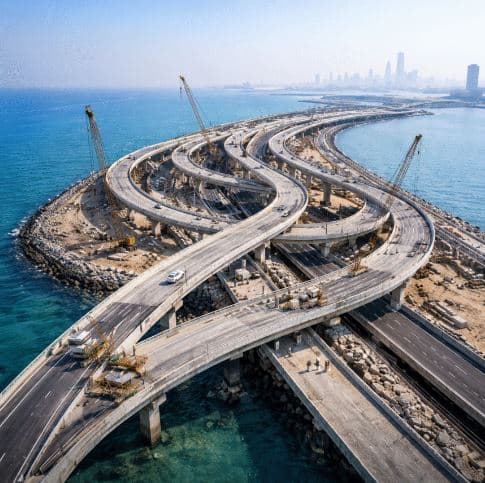
The long-pending Bhayandar–Vasai bridge project has moved a step closer towards implementation, with the Mumbai Metropolitan Region Development Authority (MMRDA) submitting a proposal to the Maharashtra government seeking approval for a revised double-decker bridge design across the Vasai Creek.
The proposed bridge, estimated to cost around ₹2,500 crore, is expected to dramatically improve connectivity between Bhayandar and Vasai by reducing the current travel distance from nearly 39 km to about 5 km and cutting journey time from nearly 90 minutes to just 10 minutes.
According to reports, the revised design includes a double-decker structure in which the upper deck will accommodate vehicular traffic while the lower level will carry Metro Line 13, creating an integrated multimodal transport corridor across the creek.
The project is expected to provide major relief to residents of the Vasai-Virar region, one of the fastest-growing suburban belts in the Mumbai Metropolitan Region. Currently, commuters travelling between Vasai and Bhayandar largely depend on congested road routes via NH-48 and Kashimira, leading to long travel times and heavy traffic congestion.
The bridge alignment has been proposed parallel to the existing Vasai Creek railway bridge, connecting Bhayandar West with Vasai West through Panju Island and Naigaon.
Originally conceived in 2000 and approved by the state government in 2013, the project has faced repeated delays due to pending environmental and land-related clearances. Officials stated that permissions from the Maharashtra Maritime Board (MMB), Inland Waterways Authority of India (IWAI), and Maharashtra Coastal Zone Management Authority (MCZMA) have already been secured.
However, approvals related to mangrove land diversion and salt pan land acquisition are still pending from the forest department and the office of the Salt Commissioner. The project also involves compensation issues concerning families associated with salt pan lands in the area.
Infrastructure experts believe the bridge could become a major catalyst for regional development by improving access between Mumbai, Mira-Bhayandar, Vasai-Virar, and Gujarat-bound corridors. The project is also expected to support future urban expansion, reduce traffic pressure on existing highways, and improve integration with upcoming metro infrastructure in the Mumbai Metropolitan Region.