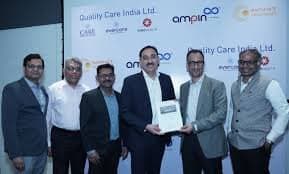
Quality Care India (QCIL) has announced the signing of agreements with AMPIN Energy Transition and Radiance Renewables under its Group Captive Solar Initiative. The agreements will enable procurement of renewable solar power for five facilities across Odisha, Chhattisgarh and Maharashtra, marking the first phase of the Group’s structured transition towards sustainable energy.
AMPIN Energy Transition will service QCIL’s facilities in Odisha and Chhattisgarh, while Radiance Renewables will execute the Maharashtra projects. The projects are being implemented under the group captive model, combining long-term renewable power procurement with equity participation. This structure enables QCIL to secure reliable, cost-effective clean energy while ensuring regulatory alignment and long-term supply stability.
The initiative is part of QCIL’s broader plan to transition 19 hospitals under CARE Hospitals and KIMS Health to renewable energy in a phased manner. Phase I spans Odisha, Chhattisgarh and Maharashtra, followed by Andhra Pradesh and Tamil Nadu in Phase II, Kerala in Phase III, and Madhya Pradesh and Telangana in Phase IV. The phased rollout is designed to ensure operational continuity while scaling renewable adoption across high-dependency healthcare assets.
Varun Khanna, Group Managing Director, Quality Care India, said, “As we scale our network, sustainability is no longer optional; it is foundational to resilience and efficiency. The Group Captive model allows us to move from being passive consumers of power to active participants in the energy ecosystem, with greater control over cost, reliability, and environmental impact. This is the beginning of a larger shift to embed sustainability into the core of how we build and operate healthcare.”
The initiative is part of QCIL’s broader plan to transition 19 hospitals under CARE Hospitals and KIMS Health to renewable energy in a phased manner. Phase I spans Odisha, Chhattisgarh and Maharashtra, followed by Andhra Pradesh and Tamil Nadu in Phase II, Kerala in Phase III, and Madhya Pradesh and Telangana in Phase IV. The phased rollout is designed to ensure operational continuity while scaling renewable adoption across high-dependency healthcare assets.
Varun Khanna, Group Managing Director, Quality Care India, said, “As we scale our network, sustainability is no longer optional; it is foundational to resilience and efficiency. The Group Captive model allows us to move from being passive consumers of power to active participants in the energy ecosystem, with greater control over cost, reliability, and environmental impact. This is the beginning of a larger shift to embed sustainability into the core of how we build and operate healthcare.”
QCIL is targeting a total renewable capacity of approximately 30 MW across its network, with Phase I accounting for around 6 MWp. Over the long term, the group aims to meet nearly 80 percent of its total energy consumption through renewable sources, supported by a hybrid model combining solar with wind and battery energy storage systems (BESS).
The transition is expected to deliver an estimated 20 percent reduction in annual electricity costs, along with improved cost visibility and insulation from tariff volatility, critical for maintaining cost stability in energy-intensive healthcare operations.
From an environmental perspective, Phase I is expected to reduce carbon emissions by approximately 8,000 tonnes annually, with the full rollout projected to offset nearly 40,000 tonnes per year across all facilities.
The shift towards renewable energy is both a strategic and operational priority, supporting cost optimisation, energy security, and environmental responsibility. With energy costs forming a significant share of hospital operating expenses, the transition is increasingly emerging as a strategic lever across the healthcare sector, the company stated.