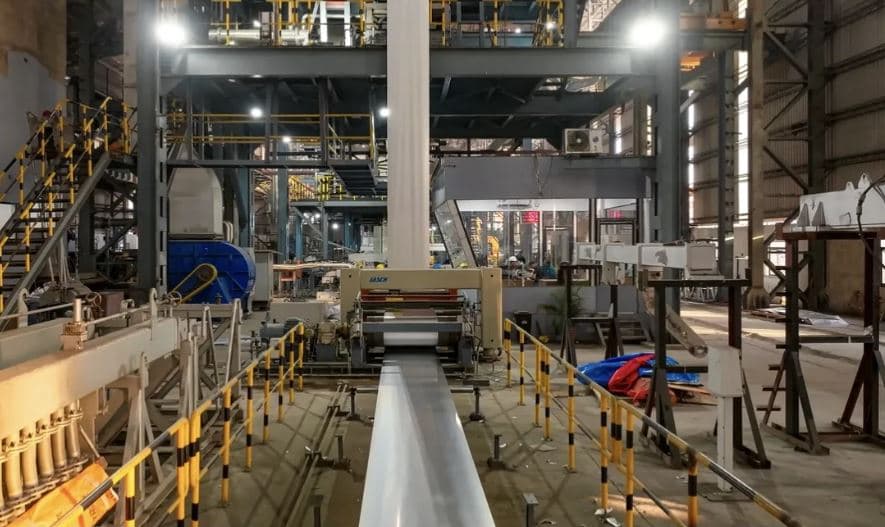
Shyam Metalics and Energy Limited has announced the commissioning of Phase II of its Cold Rolling Mill (CRM) facility for colour-coated sheets at its Jamuria plant in West Bengal. The unit, operated through its wholly owned subsidiary Shyam Sel and Power Limited, began commercial production on April 16, 2026.
The Phase II expansion includes a Dual Pot GI-cum-Galvalume (GL) processing line with a capacity of 0.15 million tonnes per annum (MTPA). With this addition, the company’s total CRM capacity has increased to 0.40 MTPA, including the existing Phase I capacity of 0.25 MTPA. The development enhances the company’s capabilities in the value-added steel segment and supports its entry into more precision-driven applications.
The expanded facility positions the company to serve the growing solar energy sector, particularly in the production of mounting structures for solar panels, an area that has traditionally relied on imports. This move aligns with India’s broader push toward self-reliance and domestic manufacturing.
The project is also aligned with the Government of India’s Production Linked Incentive (PLI) Scheme, reinforcing the company’s participation in initiatives aimed at strengthening advanced manufacturing and reducing import dependency.
Beyond renewable energy, the facility is expected to cater to high-growth sectors such as automotive and consumer durables, where demand for high-quality, engineered steel products continues to rise. The expansion further strengthens the company’s downstream integration, broadens its product portfolio, and enhances its ability to address evolving market requirements.
Strategically located in eastern India, the Jamuria plant provides logistical advantages, enabling efficient supply to key demand centres while addressing regional gaps in value-added flat steel products.
Commenting on the development, Brij Bhushan Aggarwal, Chairman and Managing Director, stated that the expansion will strengthen the company’s value-added portfolio and improve overall realizations. He noted that the new phase is expected to enhance product mix, support margin growth, and contribute to incremental EBITDA over the medium term. He also highlighted that inclusion under the PLI scheme improves the project’s return potential, while the company remains focused on disciplined capital allocation and expects optimal ramp-up within the next 10–12 months.