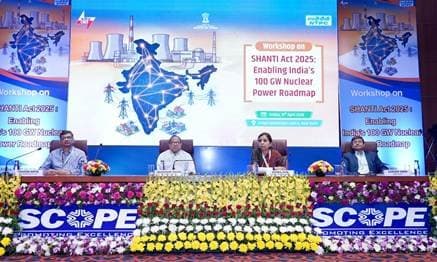
A high-level workshop on the operationalization of the SHANTI Act, 2025 was convened today at the Scope Convention Centre by the Central Electricity Authority (CEA), in collaboration with the Ministry of Power, Department of Atomic Energy (DAE), and NTPC Limited. The session focused on advancing India’s nuclear power capacity to 100 GW, a critical target aligned with long-term energy security and Net Zero commitments.
The workshop underscored the SHANTI Act, 2025 as a key legislative framework designed to enable private sector participation and accelerate nuclear power development through public–private partnerships. Deliberations centered on policy alignment, financial structuring, fuel security, and technological deployment required to scale the sector.
Shri Ghanshyam Prasad, Chairperson, CEA, highlighted nuclear energy’s role in delivering reliable, round-the-clock clean power to meet rising demand while supporting climate commitments. He stressed the importance of ensuring uninterrupted nuclear fuel supply through diversified sourcing and long-term procurement strategies.
Shri Gurdeep Singh, CMD, NTPC, emphasized the strategic importance of nuclear energy in India’s energy mix and called for expediting preparatory activities, including land identification and site assessments, to ensure timely project execution. He noted that the SHANTI Act has opened avenues for private sector participation, enabling industries to adopt nuclear energy as a viable clean power source. He further stressed the need for early formulation of regulatory guidelines, long-term fuel availability, and adherence to safety standards to strengthen energy security.
Ms. Seema Jain, Member (Finance), Department of Atomic Energy, outlined the need for financial readiness, robust risk-sharing frameworks, and strengthened institutional mechanisms to support large-scale nuclear deployment. She also emphasized global technology partnerships and innovative financing approaches to accelerate sectoral growth.
Shri Praveen Gupta, Member (E&C), CEA, highlighted the importance of coordinated efforts among government, industry, and academia to achieve India’s nuclear energy ambitions.
The workshop featured detailed discussions across seven critical areas. Key deliberations included decoding provisions of the SHANTI Act, 2025, particularly around private sector participation, graded liability frameworks, and alignment with the Electricity Act, 2003. Fuel security emerged as a major focus, with emphasis on expanding domestic capabilities and maintaining strategic reserves.
Experts stressed the importance of robust site selection processes, land acquisition frameworks, and project de-risking strategies, including the repurposing of retiring thermal power plants and enhanced coordination with state governments to expedite capacity addition.
Technology access and deployment were identified as central to the roadmap, with discussions on strengthening design support institutions, streamlining approval mechanisms, and fostering international collaborations. Localisation, supply chain development, and skill enhancement were also highlighted as essential for scaling the nuclear programme.
The need for cost competitiveness was addressed through discussions on tariff structures, standardization, indigenization, and innovative financing models. The role of Small Modular Reactors (SMRs) and Micro Modular Reactors (MMRs) was recognized as a future pathway, offering flexible, safer, and faster deployment options.
Risk management frameworks, including insurance and liability mechanisms, were emphasized as critical to ensuring investor confidence and sustainable growth in the sector.
The workshop saw participation from over 150 delegates representing 19 states, along with central ministries, regulatory bodies, public and private developers, vendors, engineering consultancy firms, academic institutions, and industry associations.