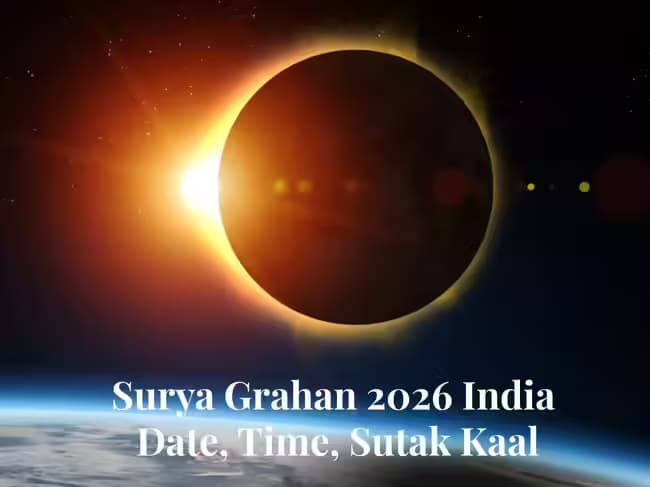
The first Surya Grahan (Solar Eclipse) of 2026 is set to occur in the early months of the year, drawing attention from astronomy enthusiasts and devotees alike. Many people in India are eager to know whether the Annular Solar Eclipse will be visible in the country and if traditional observances like Sutak Kaal will be applicable.
📅 Surya Grahan 2026 Date and Time
The Annular Solar Eclipse of 2026 is expected to take place on February 17, 2026.
Tentative Timing (Indian Standard Time – IST):
- Eclipse Begins: Around 08:30 AM
- Maximum Eclipse: Around 10:45 AM
- Eclipse Ends: Around 01:00 PM
(Timings may slightly vary depending on geographical location.)
🌍 Will the Annular Solar Eclipse Be Visible in India?
According to astronomical projections, the Annular Solar Eclipse in 2026 will primarily be visible in parts of South America, the Atlantic Ocean, and certain regions of Africa.
In India, the eclipse is not expected to be visible in full annular form. Some regions may witness a partial solar eclipse, while in many parts of the country it may not be visible at all.
Since eclipse visibility depends on geographic positioning, residents are advised to check location-specific updates closer to the date.
🕉 Will Sutak Kaal Be Applicable in India?
In Hindu tradition, Sutak Kaal is observed before a solar or lunar eclipse. It generally begins approximately 12 hours before a Surya Grahan.
However, religious scholars commonly state that Sutak Kaal is observed only in areas where the eclipse is visible.
If the solar eclipse is not visible in India, Sutak Kaal will typically not be considered applicable. In places where even a partial eclipse is visible, some devotees may choose to observe religious precautions.
🙏 What Is Sutak Kaal?
During Sutak Kaal:
- Temples may remain closed.
- People avoid cooking or eating.
- Pregnant women are advised to take extra precautions.
- Devotees chant mantras and avoid auspicious activities.
After the eclipse ends, many people take a ritual bath and perform prayers.
🔭 Safety Guidelines for Viewing Solar Eclipse
- Never look directly at the Sun without certified eclipse glasses.
- Do not use sunglasses, X-ray films, or water reflections to view the eclipse.
- Use proper solar filters or indirect viewing methods.